
Out of Home Delivery: The Infrastructure Reshaping the Last Mile
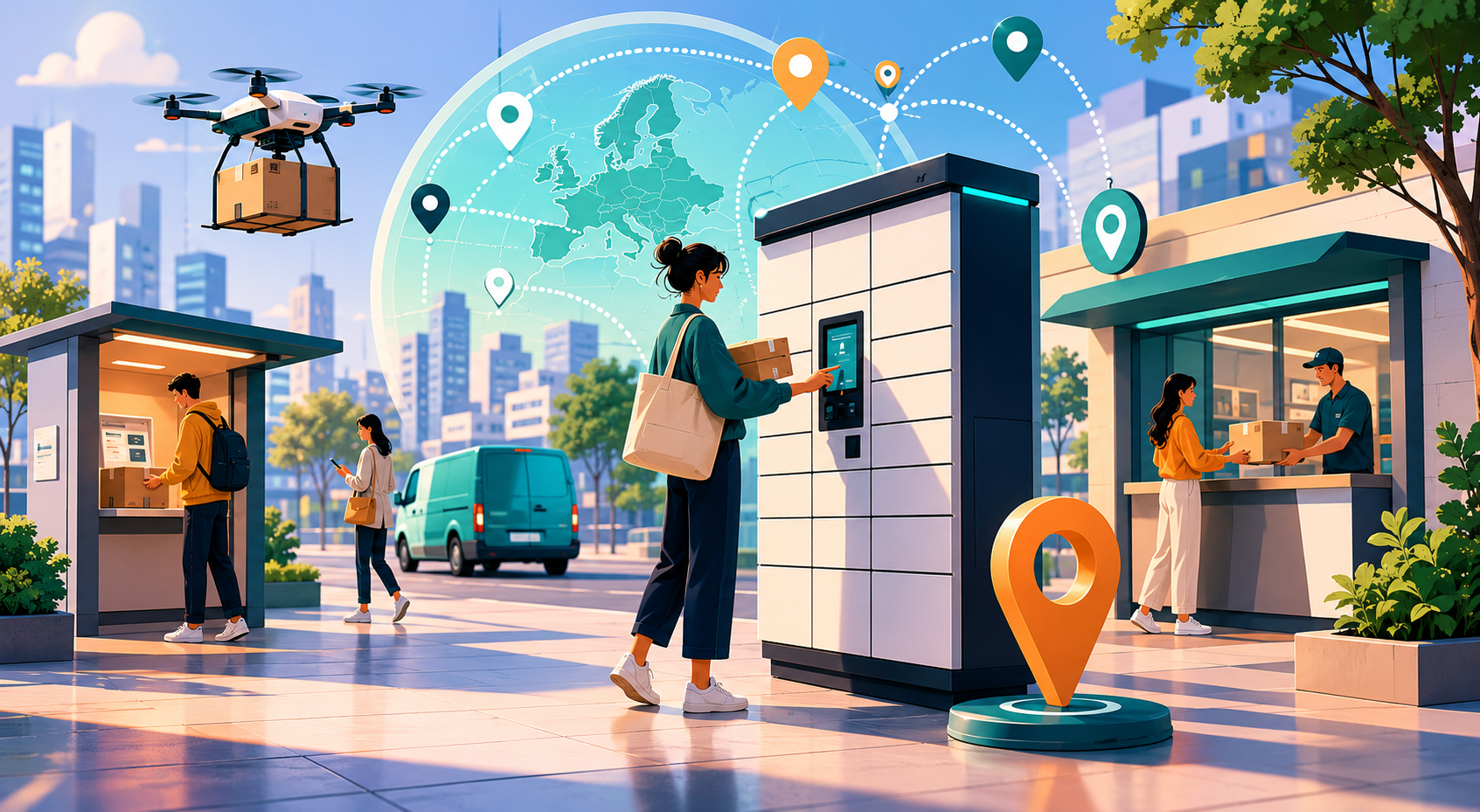
Explore our take on the past, present and future of out-of-home delivery
For years, out-of-home delivery was viewed as a secondary channel within parcel logistics. Today, it is becoming the defining infrastructure of the European last mile.
Parcel lockers, pickup and drop-off points, and automated parcel machines are evolving from niche conveniences into strategic assets that are reshaping cost models, sustainability priorities, consumer expectations, and the competitive structure of e-commerce itself.
For logistics leaders, the conversation has shifted decisively. The question is no longer whether out-of-home delivery matters, but how quickly organisations can adapt to a world where consumers increasingly expect delivery beyond the front door.
The rise of out-of-home delivery can be understood through three phases: the past, where operational pressure created the need for change; the present, where out-of-home networks have become mainstream infrastructure; and the future, where intelligent and connected ecosystems will redefine the last mile once again.
%
Mordor Intelligence's est. Annual market growth by 2030
%
DHL REPORT: EUROPEAN SHOPPERS USE OOH REGULARLY
%
NSHIFT REPORT: PEOPLE PROCESS RETURNS VIA LOCKERS OR SHOPS
The Past: Solving the Last Mile Problem
The origins of out-of-home delivery lie in one of the biggest inefficiencies in logistics: residential last-mile delivery.
As e-commerce volumes accelerated throughout the 2010s, carriers struggled to scale a delivery model that was never designed for such intensity, leaving drivers to contend with growing parcel volumes, congestion, failed delivery attempts, and rising consumer expectations.
As volumes increased, the economics quickly became unsustainable, with the last mile emerging as the most expensive stage of parcel logistics and accounting for well over half of delivery costs in many urban markets. Every failed delivery compressed margins further, creating the conditions for a different approach to emerge.
“Customers grab their parcels when it suits them. No missed deliveries, no sorry we missed you cards, and no soggy boxes left in the rain.” – InPost 2025
That approach was out-of-home delivery. Early locker networks appeared in Europe during the 2000s, particularly in Germany and Poland, although adoption remained relatively limited as consumers continued to associate convenience with home delivery.
Operators, however, quickly recognised the efficiency benefits of consolidating dozens of residential stops into a single locker bank or collection point located within a consumer’s existing routine.
The COVID pandemic accelerated that shift dramatically. As online shopping surged across Europe, traditional home delivery networks came under enormous pressure, pushing out of home delivery from an optional channel to an operational necessity almost overnight.
Consumers embraced self-service collection models, while operators experienced scalability and efficiency benefits at scale, helping European locker networks handle more than 2.3 billion parcels in 2024 alone.
The Present: STRATEGIC INFRASTRUCTURE
Today, as consumer expectations continue to evolve, out-of-home (OOH) delivery is emerging as a key pillar of modern e-commerce logistics. From local parcel shops in the UK to smart locker networks in China, OOH is reshaping the final mile, helping retailers deliver greater convenience, efficiency, and sustainability at scale.
- China has arguably reached infrastructure status, with lockers described as being as common as letterboxes in many residential areas and often serving as the default last-mile option in cities.
- Poland is Europe’s standout locker market, with 65% to 70% of consumers preferring parcel lockers and many choosing them even when home delivery is available.
- Germany has achieved mainstream adoption, with more than 60% of parcels delivered via lockers or parcel shops and a network of over 13,000 lockers and 29,000 parcel shops.
- France has built its success around PUDO, with more than 80% of online shoppers having used click and collect or parcel shops, supported by over 40,000 pickup locations.
- Japan has achieved strong penetration, with 41% of consumers regularly using lockers or pickup points, driven by convenience, privacy, and punctuality.
- Sweden demonstrates how quickly behaviour can change, with locker usage rising from 3 per cent in 2020 to 15% today, supported by strong sustainability preferences.
- The UK remains at an earlier stage, with OOH accounting for around 15% to 20% of parcel volumes, although 70% of consumers have used click and collect at least once, and network expansion is accelerating.
Across Europe, parcel locker networks and collection points are expanding rapidly as carriers race to build density, secure strategic locations, and strengthen consumer loyalty.
This maturity, however, is far from uniform across Europe. Adoption patterns vary significantly between markets, and understanding that map is essential for network investment decisions. Baltic and Central European markets lead on locker penetration, reflecting earlier and more aggressive investment.
Western markets such as France, Belgium and Ireland sit lower on adoption despite dense urban infrastructure. The gap is partly legacy and partly strategic: operators who built network density early created consumer habits that are now very difficult to displace.
More than 180,000 automated parcel machines are now installed across the continent, growing at 28% year on year, while the European out-of-home market is projected to reach a value of $7 billion in 2025.
This transformation is being driven by a combination of operational efficiency, sustainability priorities, and changing consumer behaviour.
From an operational perspective, consolidating dozens of parcels into a single drop location reduces mileage, labour costs, congestion, and failed delivery attempts, making out-of-home delivery increasingly attractive in a market defined by rising wage pressures and tighter margins.
- Gen Z Have Used Parcel Lockers 71%
- Millennials Have Used Parcel Lockers 68%
- Say Lockers Are Greener Than Home Delivery 64%
Data from InPost’s Report Retail Economics 2024
At the same time, environmental regulation and corporate net zero commitments are reshaping logistics procurement decisions, with consolidated delivery models offering one of the clearest pathways towards lower emissions and more sustainable urban logistics.
Consumer behaviour is also changing. Convenience is no longer defined purely by speed, but increasingly by flexibility and control, as shoppers seek delivery options that fit naturally around work, commuting, and daily routines.
This has created what many operators describe as a proximity economy, where the closer a locker or collection point is to a consumer’s routine, the more likely it is to become part of their everyday behaviour.
In mature markets such as Poland, out-of-home delivery has already become a habitual infrastructure rather than an alternative service, with automated parcel machine networks achieving on-time delivery rates of up to 98%.
Returns are accelerating this shift further, as consumers increasingly prefer lockers and retail drop-off points to more traditional return methods.
As a result, competition across the sector has intensified, with postal operators, carriers, marketplaces, and retailers all investing aggressively in infrastructure expansion. The battleground is no longer simply delivery speed, but accessibility, convenience, and network density.
The FUTURE: INTELLIGENT LOGISTICS NETWORKS
The next phase of out-of-home delivery will be shaped less by the number of lockers deployed and more by the intelligence powering them.
Artificial intelligence is already transforming how networks are planned and operated, enabling operators to forecast parcel volumes, optimise locker placement, and manage peak capacity in real time. Those that successfully integrate AI into network planning stand to gain high cost and efficiency advantages.
At the same time, consumers increasingly expect seamless experiences across retailers, carrier apps, vehicles, and delivery infrastructure, turning the locker from a standalone hardware asset into part of a connected digital ecosystem.
Advances in battery-powered and wireless automated parcel machines are also enabling faster deployment in locations where traditional infrastructure constraints previously limited expansion.
Looking further ahead, out-of-home infrastructure is expected to integrate with autonomous vehicles, robotics, and drone technology, transforming lockers into intelligent urban distribution nodes connected directly to micro fulfilment hubs and automated transport systems.
For logistics leaders, the implications are clear. Network density, digital capability, and infrastructure partnerships will increasingly determine competitive advantage, while organisations that successfully combine physical reach with intelligent technology platforms will be best positioned to capture future growth.
“Out-of-home delivery is no longer the alternative last mile. It is the only sustainable, scalable path forward for European e-commerce.” – The Last-Mile Paradigm Shift, 2025
Out-of-home delivery is no longer simply an operational improvement. It is becoming the infrastructure layer underpinning modern commerce itself, and the organisations that recognise that shift early, invest in density, and build integrated ecosystems around convenience and sustainability will define the future of European logistics.
At WMX Europe 2026, this session brings together leading voices from across the sector to explore the full OOH picture, from lockers and PUDO growth to returns, convenience, and changing consumer behaviour. Expect strategic insight into what it will take for OOH to move from an alternative option to true delivery default.